Quiet Owl 815@quiet-owl-8150 Views
Asymptotes Explained: Vertical, Horizontal and Oblique
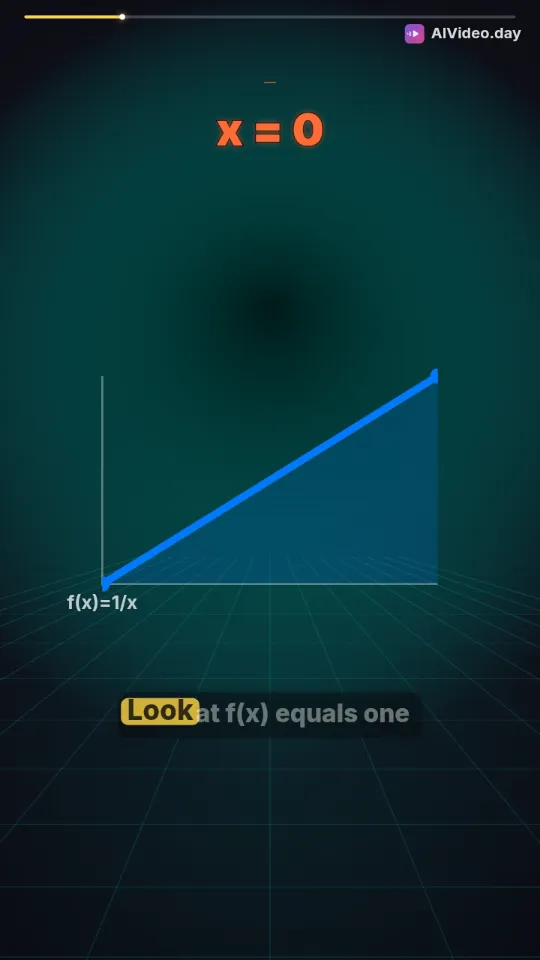
Ever wonder why some graphs get closer to a line but never actually touch it? That's an asymptote. First, the Vertical Asymptote. Look at f(x) equals one over x. As x gets close to zero, y shoots up to infinity. Next, the Horizontal Asymptote. If we shift that curve up by two, like f(x) equals two plus one over x, the graph flattens out at y equals two. Finally, the Oblique Asymptote. This happens when the top of your fraction is bigger than the bottom. The graph slants along a diagonal line. So remember: vertical for zeros in the denominator, horizontal for flat lines, and oblique for slanted ones. Master these, and you master limits!
Made with AI by a creator on AIVideo.day
Make a video like thisComments
Script
Ever wonder why some graphs get closer to a line but never actually touch it? That's an asymptote. First, the Vertical Asymptote. Look at f(x) equals one over x. As x gets close to zero, y shoots up to infinity. Next, the Horizontal Asymptote. If we shift that curve up by two, like f(x) equals two plus one over x, the graph flattens out at y equals two. Finally, the Oblique Asymptote. This happens when the top of your fraction is bigger than the bottom. The graph slants along a diagonal line. So remember: vertical for zeros in the denominator, horizontal for flat lines, and oblique for slanted ones. Master these, and you master limits!